




Edellinen viesti
The evolution of wood texture melamine boards has followed a clear technological path: from the earliest flat printing – where wood texture melamine was "painted" on the surface – to synchronised embossing, where texture and embossing began to align – and then to deep embossing, where wood texture melamine is no longer a flat pattern but a three‑dimensional tactile experience.
The starting point of YAKCO Wood Texture Melamine Faced Board's process is3D boards with deep texture of 50 microns (0.5mm) and above. What does 0.5mm mean?
The thickness of a standard business card is approximately 0.3mm, so 0.5mm is roughly the height of one and a half business cards stacked together.
In 2015, YAKCO pioneered the development of 3D boards at this depth, simulating realistic 3D stereoscopic textures and tactile sensations, and quickly introduced them to the European market.
More: yakco technology
For wood texture melamine boards, this depth means: the grain of oak is not just "printed" but "embossed" – when you run your finger over it, you can feel the rise and fall of annual rings, the depressions of vessels, and the direction of the texture.
The following sections break down, from both process logic and test data perspectives, how 0.5mm deep embossing transforms wood texture melamine from "flat printing" into "three‑dimensional tactile feel."
1. 0.5mm Deep Embossing: From "Seeing Texture" to "Feeling Texture"
The embossing depth of traditional wood texture melamine boards is typically between 0.2mm and 0.4mm. This depth is enough to give the surface a "textured feel," but when you run your finger over it, the sensation is more like "a smooth surface with some shallow marks" – like frosted paper, rather than real wood texture melamine.
0.5mm deep embossing is completely different.
At this depth, the vessel areas of the wood texture melamine form distinct depressions, and the annual ring areas form clear raised sections. When you run your finger along the direction of the oak grain, you can feel the "undulation" of the texture – just like touching a real wood surface.
Deep textures of 50 microns and above are defined in the industry as the threshold for "genuine deep texture" – below this depth, the tactile feel remains at the level of "having texture"; at or above this depth, the tactile feel enters the realm of "having rise and fall."
YAKCO's 3D deep‑texture pressing line, through its fully automatic variable‑area pressure control system and short‑cycle press with high heat transfer efficiency, achieves precise control of the pressure curve and pressure distribution required for deep textures.
This means that the 0.5mm deep texture is not "forced" by high pressure, but "shaped" through precise process control – full vein, clear edges, no distortion, no deformation.
2. The "Process Cost" of Deep Embossing: Why Can't All Boards Be Embossed at 0.5mm?
Deep embossing is not a matter of "the deeper, the better." An embossing depth of 0.5mm places extremely high demands on the substrate:
The substrate density must be uniform.
If the substrate density is uneven, areas with higher density will be embossed shallower, while areas with lower density will be embossed deeper – on the same board, the texture depth varies, visually appearing "blurred."
YAKCO's substrate density is stable at 0.72 g/cm³, with uniform distribution, ensuring consistent embossing depth across the entire board.
The substrate's internal bond must be sufficient.
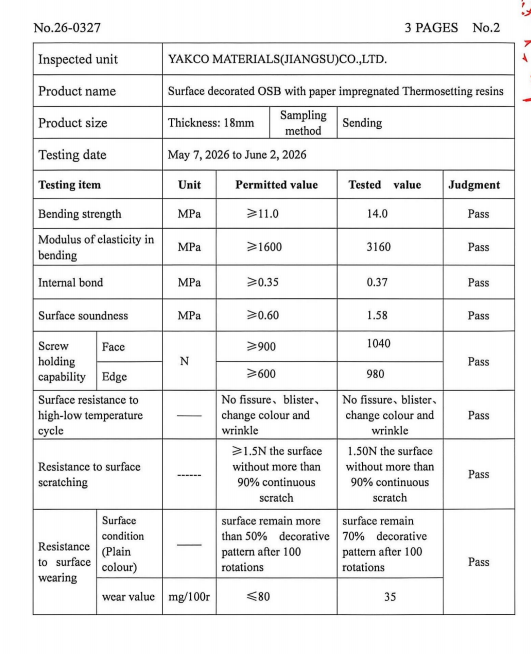
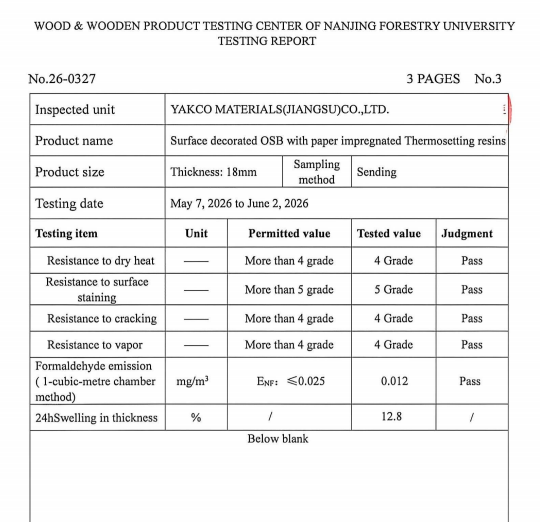
During deep embossing, the raised areas of the steel plate exert far greater pressure on the substrate surface than during shallow embossing. If the substrate's internal bond is insufficient, the surface layer will "collapse" under pressure, resulting in an actual embossing depth less than the steel plate's designed depth – the texture "becomes shallower." YAKCO's substrate internal bond of 0.37 MPa (higher than the national standard of 0.35 MPa)ensures that the substrate does not collapse or shrink during deep embossing.
The bond between the decorative layer and the substrate must be strong.
During deep embossing, the decorative layer is subjected to extreme stretching and compression at the edges of the texture.
If the surface soundness is insufficient, the decorative layer will experience slight "rebound" at the texture edges – the texture is clear when the steel plate presses down, but the edges shrink slightly after release, causing the texture boundaries to become blurred.
YAKCO's surface soundness of 1.58 MPa (2.6 times the national standard of 0.60 MPa) ensures that the deep texture edges remain clear, without delamination or rebound.
3. The Real‑World Value of 0.5mm Deep Embossing
0.5mm deep embossing translates into three practical values in real‑world use:
Tactile realism.
This is the most direct value. The 0.5mm depth allows the concave-convex of the wood texture melamine to be clearly perceived by the fingers – the vessel depressions of oak, the annual ring concave-convex of walnut, the fine texture of cherry – these tactile details transform the wood texture melamine board from "looking like wood texture melamine" to "feeling like solid wood."
When YAKCO introduced this technology to the European market in 2015, the core selling point was precisely "simulating realistic 3D stereoscopic textures and genuine tactile grain."
Visual layering.
Deep embossing creates richer light reflection and shadow on the textured surface.
wood texture melamine with shallow embossing looks clear under direct light, but "flattens" under side light; wood texture melamine with 0.5mm deep embossing has a three‑dimensional look from any angle – shadows form in the depressions, highlights form on the raised areas, and the layering of the wood texture melamine is enhanced.
Long‑term durability.
An embossing depth of 0.5mm means a greater "wear margin" for the decorative layer.
Even after years of daily cleaning and wiping, the concave-convex feel of the texture remains – it is not "worn flat." YAKCO's wear value of 35 mg/100r, far better than the national standard requirement of ≤80 mg/100r, ensures that the tactile feel of the deep texture remains clearly perceptible after years of use.
4. The "Engineering Assurance" of Deep Embossing: From Laboratory to Real Space
Achieving 0.5mm deep embossing is not simply a matter of "increasing the pressure." It requires the coordinated assurance of the entire production line:
Precision of the pressing equipment.
YAKCO's 3D deep‑texture pressing line was developed and manufactured by Suzhou Huaxiang Wood Machinery Co., Ltd. in 2018, and is the first truly deep‑texture pressing equipment of its kind in China.
The line integrates multiple functions including automatic multi‑layer paper feeding, double‑sided precise synchronised pattern alignment, fully automatic variable‑area pressure control, fully automatic multi‑edge chamfering, and automatic stainless steel backing plate replacement.
These systems ensure consistent embossing depth, precise texture alignment, and smooth flat edges on every panel.
Batch consistency of the substrate.
If different batches of substrate have different densities, the same pressing process will produce different embossing depths.
YAKCO's narrow‑window quality control ensures that the density, internal bond, and surface soundness of every batch of substrate are consistent. The oak grain of the first batch and the oak grain of the tenth batch have the same depth and the same tactile feel.
Verification through test data.
The "durability" of 0.5mm deep embossing is not based on perception – YAKCO uses the data of wear value 35 mg/100r, surface soundness 1.58 MPa, and internal bond 0.37 MPato prove that deep textures are not "fragile items".
5. Conclusion: The "Tactile Revolution" of wood texture melamine Begins at 0.5mm
The evolution of wood texture melamine boards is, at its core, an evolution of "realism" – from flat printing to synchronised embossing, from shallow embossing to deep embossing, each step bringing wood texture melamine closer to the tactile experience of natural wood.
0.5mm deep embossing is a key milestone on this evolutionary path – YAKCO was the first to cross this threshold in 2015.
YAKCO Wood Texture Melamine Faced Board uses the combination of 0.5mm deep embossing, a wear value of 35 mg/100r, and surface soundness of 1.58 MPa to prove that deep textures are not "beautiful but short‑lived" decorations – they allow you to feel the annual rings, and they withstand time.
When a designer says, "I want the wood texture melamine to feel like solid wood," YAKCO responds with 0.5mm deep embossing, answering the unspoken question: "Not just like it – you can actually feel it."